Case law you can actually cite.
Every authority comes from the Free Law Project and links to the real opinion — so you verify before you file. It can't cite a case that doesn't exist.
“Find controlling authority on warrantless dog sniffs at a home.”
No hallucinated cases
Citations are retrieved from real, public-domain opinions — never invented.
One-click verification
Open the full source opinion before it ever reaches a filing.
Grounded answers
Research is anchored to authority you can read for yourself.
Real cases, ranked and linked
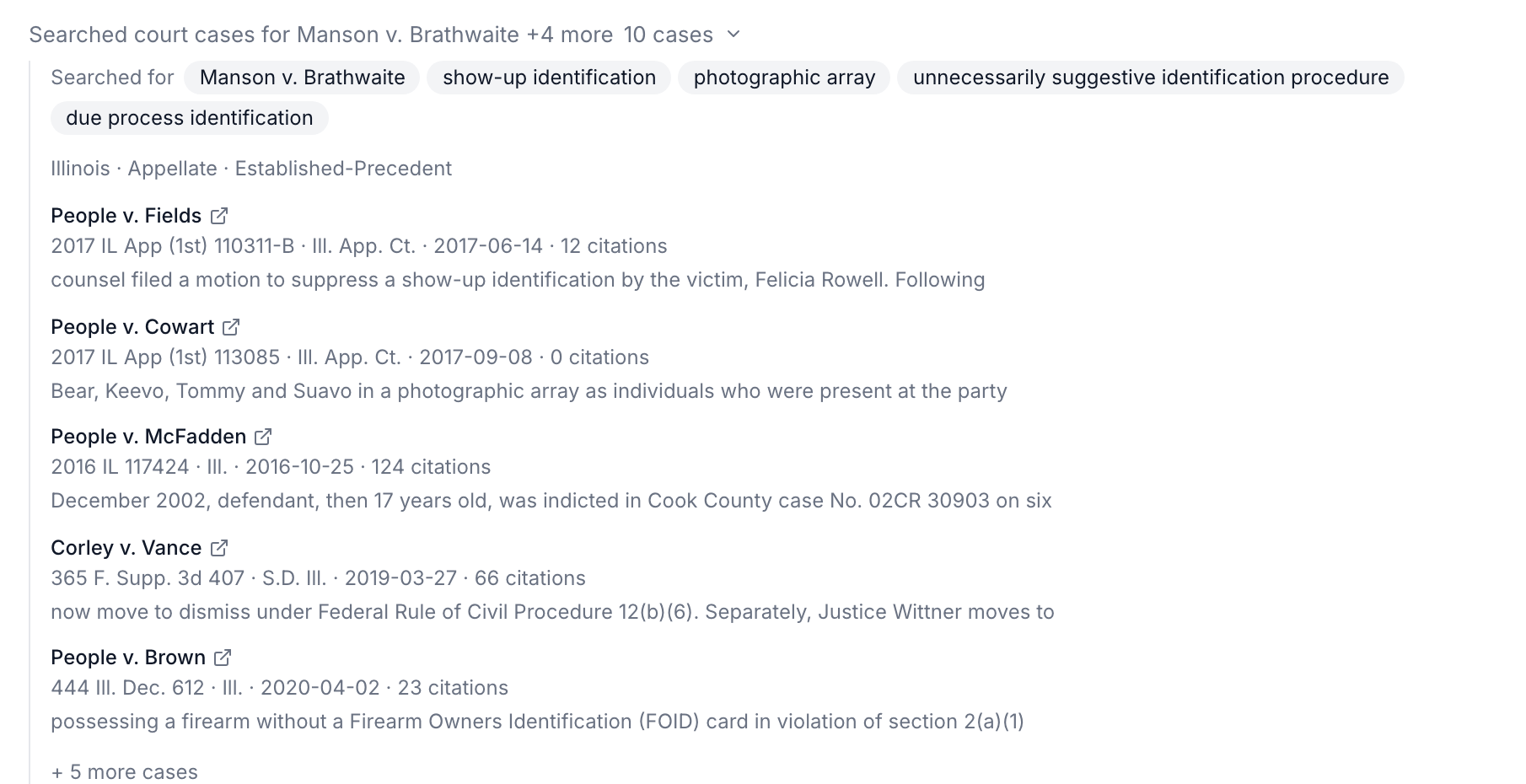
Research runs against the Free Law Project's public archive of court opinions — federal courts and all fifty states. Every search shows its work: the exact queries it ran, the jurisdiction it searched, and each result with its citation, court, date, and how often it's been cited — with a link out to the full opinion.
The assistant narrates as it goes. When a first search comes back too narrow, you watch it reason about why and go broader — the same way you'd redirect a junior associate, except it redirects itself.
Quotes are checked against the opinion — verbatim
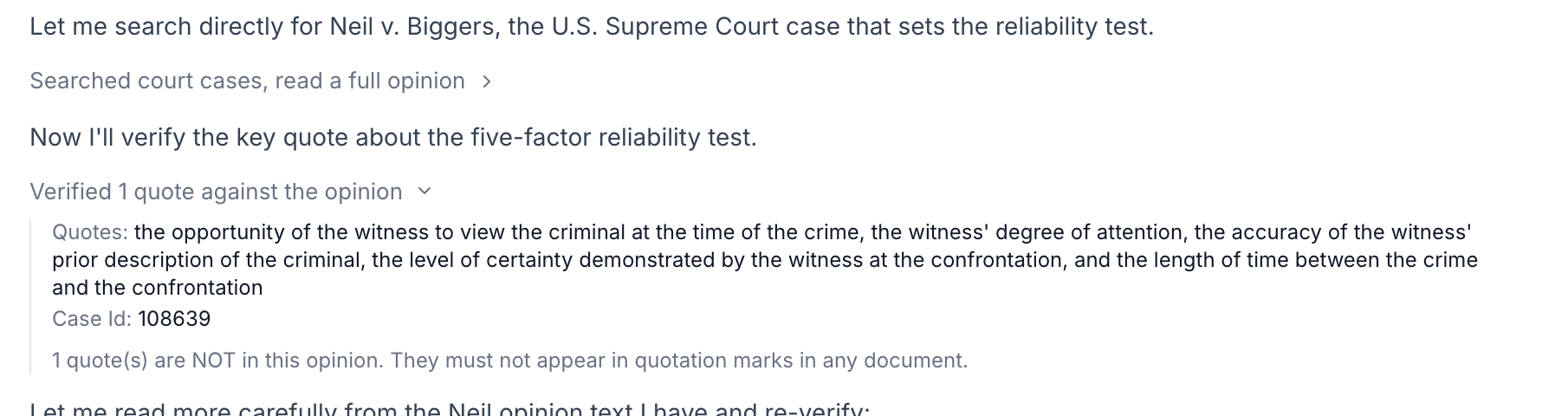
Language in quotation marks is held to a hard rule: it must appear word-for-word in the opinion's actual text. Before quoting a case, the assistant runs the passage against the full opinion and reports the match.
And when a quote doesn't check out, you see that too — the tool answers plainly that the language is not in the opinion and must not appear in quotation marks, and the assistant re-reads the source and corrects itself before the language can reach a draft.
Audited again at the moment it matters
Verification isn't a research-time nicety — it re-runs automatically every time a document or email is saved, on every citation in the text.
Citations must resolve
Every reporter citation in a saved draft is looked up against the real opinion database; a nonexistent case is flagged as a problem the assistant must fix.
Quotes must match
Every quoted passage attributed to a case is re-verified verbatim against the opinion — fabricated or altered quotes can't survive a save.
Majority means majority
A quote sourced from a dissent or concurrence is flagged, so a filing never leans on authority the opinion doesn't carry.
Honest about limits
If verification is ever unavailable, the draft says its citations are unverified — it degrades loudly, never silently.
Research tools an associate would envy
Beyond search-and-quote, the assistant carries a full research toolkit over the same public corpus.
Read the whole opinion
Full opinion text — majority, concurrences, dissents — pulled into the conversation, not just headnotes.
Follow the citation network
Find similar precedents through what a case cites and what cites it, not just keyword overlap.
Federal dockets
Search PACER dockets and parties through the RECAP archive to track related federal litigation.
Procedure and trends
Look up procedural requirements by jurisdiction and survey how courts have been deciding an issue over time.